
CFCC Veterinary Medical Technology Students Gain Hands-On Large Animal Training at NC State
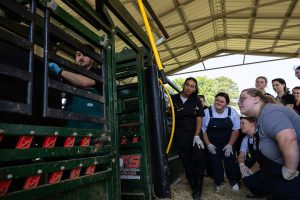
Dr. Jake Eldridge demonstrates a tail vein venipuncture for CFCC students on a cow from the beef cattle teaching animal unit on the College of Veterinary Medicine Campus. The cow is contained in a “chute” for the safety of the animal and the medical provider.
Twelve CFCC Veterinary Medical Technology (VMT) students stood in line waiting to enter NC State’s 80-acre working farm. Donning rubber boots and coveralls, they embarked on a day of experiential learning with the College of Veterinary Medicine’s Teaching Animal Unit.
NC State alumnus Dr. David Brazik is the attending veterinarian and an instructor for CFCC’s Veterinary Medical Technology program. Last year, he connected with Lauren Buslinger, a Registered Veterinary Technician (RVT) and preclinical laboratory instructor at NC State’s College of Veterinary Medicine. Under her leadership, the “Livestock Bootcamp” was born. This all-day experience invited CFCC students to NC State’s biomedical campus, providing them with firsthand insight into large-animal veterinary care.
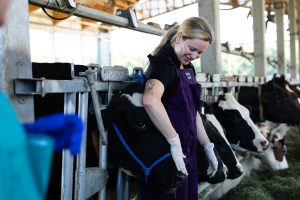
Registered Veterinary Technician (RVT), Lauren Buslinger, demonstrates haltering on a dairy cow at the NC State Dairy Barn on the College of Veterinary Medicine Campus.
Veterinary medical technicians play a unique role in veterinary settings, providing intake care, conducting assessments, and performing technical procedures. More importantly, they help ensure a safe environment for both animals and their owners. The same vet tech who cares for a puppy may also be responsible for a snake, hamster, or horse. That’s why experiences like the Livestock Bootcamp matter. They expose students to a wider range of species and prepare them for the variety of cases they may encounter in practice.
“The biggest problem we’re facing right now in veterinary medicine is that we have veterinary deserts,” said Lauren Buslinger, RVT, preclinical laboratory instructor at NC State’s College of Veterinary Medicine. “We don’t have enough bodies to fill the need for the amount of animals that appear in the state and in the country.”
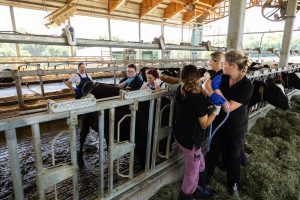
Three CFCC students (left) and two RVTs (right) perform a test on a dairy cow’s rumen using an inutbation system and listening via stethoscope. The rumen is the first chamber of a cow’s digestive system and acts as a fermentation vat for the animal.
According to Buslinger, the shortage is especially pronounced in large-animal medicine, where veterinarians and veterinary support staff are increasingly difficult to recruit and retain. Programs like the Livestock Bootcamp aim to help bridge that gap by introducing students to species and practice areas they may have little opportunity to encounter elsewhere.
“A lot of people don’t have the exposure to these species or the access to learn about them,” Buslinger said. “We want to get them comfortable and supported.”
For CFCC students, the experience meant far more than observing from the sidelines. Throughout the day, students practiced animal restraint techniques, learned livestock-handling procedures, tested milk samples for mastitis, and worked alongside veterinary professionals in a working farm environment.
The hands-on experience reinforced a lesson Dr. Brazik emphasizes throughout the Veterinary Medical Technology curriculum. Learning happens differently for everyone.
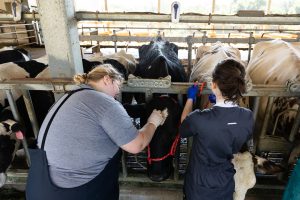
Two CFCC students practice haltering a dairy cow at the NC State Dairy Barn on the College of Veterinary Medicine Campus.
“We all learn in different ways,” Brazik said. “Some people are very good about reading it out of a book. Some people have to see a picture of it. Some people have to see the animal in front of them. Even though we’re not teaching anything different, it’s being taught in a different way that may click for someone.”
That approach is especially important in a profession that demands a broad skill set. Veterinary medical technicians graduate with training in radiology, dentistry, anesthesia, surgical assistance, laboratory procedures, and patient care, often caring for a wide variety of species throughout their careers.
“In veterinary medicine, you never know what you’re going to get that day,” Brazik said. “You have your schedule, but there are always walk-ins. You don’t know what’s going to happen.”
For student Emily Wood, the program offered a direct path toward a career built around a lifelong passion for animals.
“I chose to be a vet tech because I fell in love with animals at my grandfather’s farm,” Wood said.
Previous experience with farm animals wasn’t the only reason students were inspired to pursue veterinary medical technology. Classmate Mary Suther was originally pursuing nursing before discovering the VMT program.
“I’ve always loved the medical field and, obviously, animals,” Suther said.
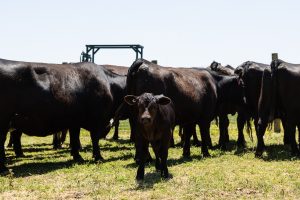
A calf from NC State’s beef cattle TAU looks at the camera.
The visit also highlighted the growing demand for veterinary medical technicians nationwide. The American Veterinary Medical Association recommends two veterinary technicians per veterinarian, a benchmark that many practices struggle to meet.
“There is a need for veterinary technicians in the veterinary industry,” Brazik said. “Getting valuable, educated individuals into the field is necessary.”
Though the visit lasted only a day, the lessons learned will stay with students as they continue their education and enter the profession.
A special thank you to the NC State College of Veterinary Medicine for hosting our students and providing such a valuable experiential learning opportunity.
To learn more about the CFCC Veterinary Medical Technology program, visit: https://cfcc.edu/veterinary-medical-technology/