
Katie Crouse Overcomes Doubts and Discovers Her Calling in Engineering
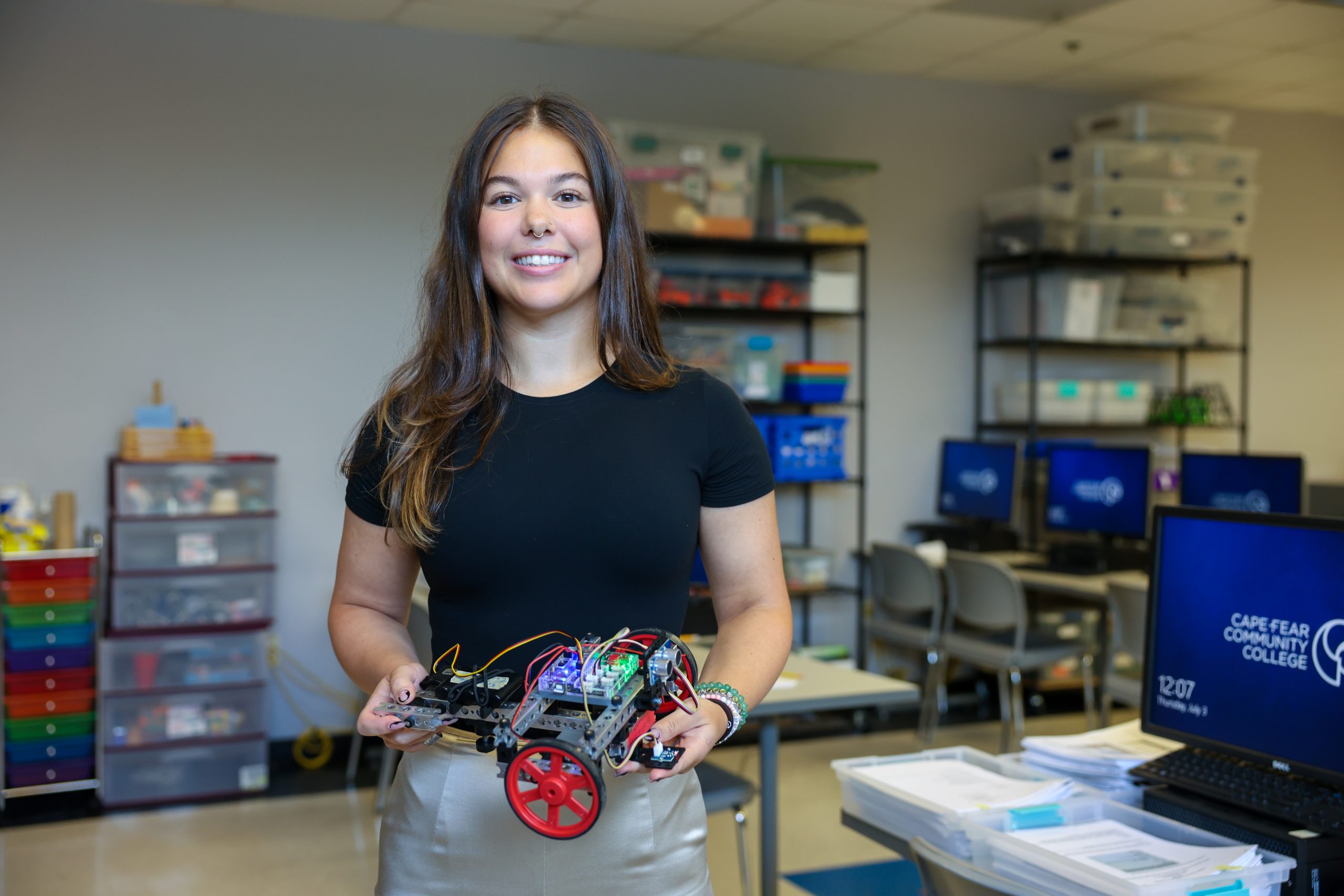
When Katie Crouse left her small hometown in Vermont, she wasn’t planning to study engineering. She just knew she wanted to do something meaningful. At first, she pursued law, then computer science, hoping one of those paths would fit.
“I thought the only way to enact change in the world was through politics,” she said. But neither felt quite right.
“I was still trying to figure out what I wanted to do, and that’s kind of how I came to Cape Fear.”
At Cape Fear Community College, Katie found the space and support to explore her interests. She began asking bigger questions while working toward her Associate in Arts degree.
“I’ve always wanted to live in a different country and learn about different cultures and how people use the materials they have access to, to build,” she said. “That curiosity is what led me toward engineering.”
A Pivotal Conversation
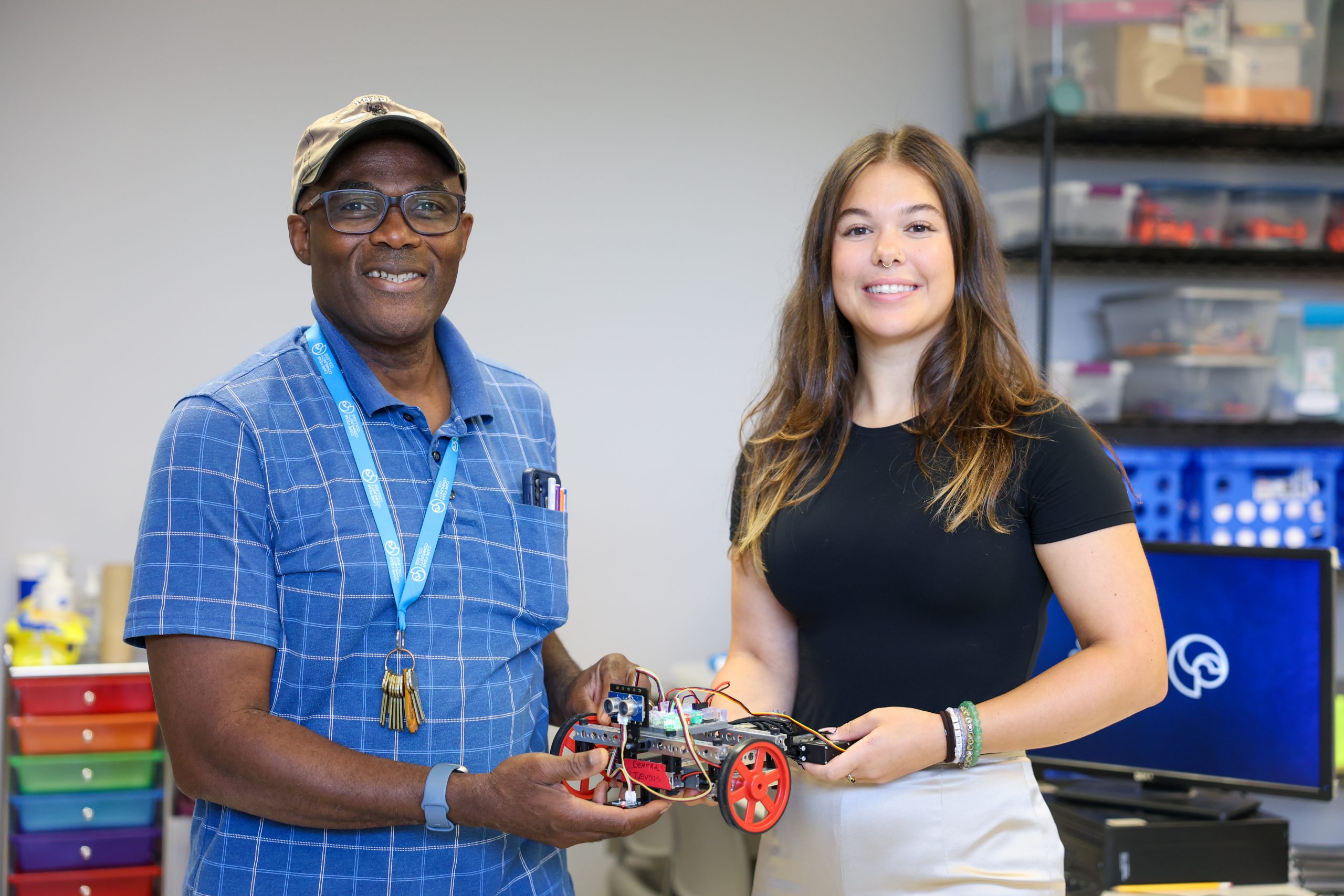
Katie contacted Career Services Director Gina Mecca, who introduced her to Dr. Hans Chapman, Program Director of the Associate in Engineering program.
“When I met Dr. Chapman, he was so friendly,” Katie said. “He asked me about my passions back home, and I started telling him about my high school experiences.”
She recalled field trips to hydroelectric plants and learning about solar panels. “I didn’t even realize that was engineering,” she said. In her AP environmental science class, her final project was on erosion and water quality in rivers near her hometown, work that connected science to real community impact.
During that first visit, Dr. Chapman helped Katie plan her next steps. But when she saw the list of courses; physics, calculus, statics – she felt overwhelmed.
“I remember reading ‘statics’ and thinking it said ‘statistics,'” she laughed. “I didn’t even know what that meant.”
“I told him I needed time to think it over,” Katie said. “He told me, ‘That’s okay. Even if you decide to take another path, you should return to engineering someday because this is your calling.'”
“He believed in me before I even believed in myself. It really took just one person.”
Finding Her Footing
After that conversation, Katie kept working toward her Associate in Arts degree, but engineering stayed on her mind. She set a personal goal in her Calculus I class with Professor Shana Biggs.
“I told myself if I scored above a certain percentile, I’d commit to taking Calculus II and pursuing engineering,” she said. When Professor Biggs returned her exam, she had written at the top, ‘You are so ready for Calc II.’
“I still have that paper. It was so affirming.”
Still, not everything came easily.
“Physics was one of the hardest classes,” Katie said. “My first exam, I got a 43. I remember having dreams that I didn’t belong. But I found a tutor on my own and ended the class with a B. I had the greatest academic comeback,” she laughed.
Katie thrives when her coursework connects to real-world problems. One favorite moment came during a physics lab with Professor Trevor Steinke.
“It was a lab he’d never done before, and the results didn’t match what he expected,” she said. “He challenged us to figure out why. I asked if this was what it’s like in a real physics lab, and he said, ‘This is exactly what it’s like.’ That stuck with me.”
She credits perseverance and a willingness to ask questions and ask for help as her biggest lessons.
“As a woman in engineering, it can be scary. You want to prove yourself. But you have to shake that fear and realize you can ask for help. That’s not a weakness.”
A Future Built on Purpose
Katie plans to transfer to NC State and is considering civil or materials engineering.
“I’ve got big ideas,” she said. “I want to focus on humanitarian work and use engineering to support underserved communities. I want to figure out how to use natural resources to our advantage in a way that helps people. I may even want to join the Peace Corps someday.”
As a recipient of a significant engineering scholarship and co-president of the Student Engineers Club at Cape Fear Community College, Katie holds herself to high standards. Her advice to students, especially women considering engineering, is clear.
“Don’t be afraid to ask questions. Don’t be afraid to ask for help. Hold yourself to a high standard, but don’t think you have to do it all alone. You’ve got to have semi-thick skin, but there’s a place for you here.”